


THE ROOM REMEMBERED YOU

Ten Years Inside Lil’ Deb’s Oasis
By Larie Pidgeon
Archive photographs courtesy of Lil’ Deb’s Oasis unless otherwise credited.
Before dinner at Lil’ Deb’s, somebody lit the candles.
Aristilde Kirby remembers the Catholic-style velas near the altar, family meal, the specials to memorize and those last few minutes before the room belonged to everybody else. Floryn and Alé gave her pointers. Hannah was smiling. Halo was behind the grill looking so serious that Aristilde can still see the expression years later.
Then the doors opened.
Tables filled. The floral oilcloth needed wiping beside people who were still eating. The kitchen needed something from the floor, the floor needed something from the kitchen, and everybody had to make all of that scrambling look intentional.
Wheeler had a phrase for the job.
Be a swan.
Calm up top. Feet working like hell underneath.
Years later, Kelly Joyce came into a completely different generation of the same restaurant and found the same basic rule underneath it: pay attention to one another. Notice who is buried. Fill the gap before the room feels it.
The pink room is the easy part to remember. The people who made it feel effortless are easier to lose.
There were awards. National magazines. James Beard nominations. A cookbook. People came to Hudson because they had read about this strange little restaurant on Columbia Street.
But before any of that, there was a room learning people.
2015 — BEFORE THE OASIS
The room had belonged to another woman first.
Debbie Fiero had run Debbie’s Lil’ Restaurant there, a real Hudson diner, long before Lil’ Deb’s became the place people photographed on weekend trips upstate. Annie Bielski remembers stopping there for pancakes in 2015 and watching Debbie hand a man at the counter an entire bottle of chocolate sauce so he could make his chocolate milk exactly right. When Annie asked for the pancakes she could not finish to go, Debbie cooked the rest of the batter and doubled the order.
At night, the room started becoming something else.
Annie would leave her studio-assistant job a little early, help change the lights and hang art, then waitress even though she had never waitressed before. Halo and Hannah gave her one instruction: “pretend like you are acting.” One night she waited on Halo’s mother, grandmother and cousin and remembers being especially nervous because she wanted them to have a good time.
Halo and Hannah were taking over the diner on Tuesday nights for pop-up dinners: bring in art, change the lighting, cook, serve everybody, then take the room apart again when the night was over. When Debbie retired the following year, they took over the restaurant for good.
They kept part of her name.
The rest of the place changed pretty dramatically.

The old Debbie’s neon survived inside the room as Lil’ Deb’s became its own strange, colorful place. Courtesy of Lil’ Deb’s Oasis.
Halo grew up in Queens, raised by three Ecuadorian women in a home with a busy kitchen. Hannah came from Alabama, studied painting and cooked professionally, including at Mission Chinese Food in New York and Hartwood in Tulum. Both of them were artists before a restaurant became the thing they were making together.
You can see that in the stories from before Lil’ Deb’s had a dining room of its own.
One of those stories starts with a van to Miami.
In December 2015, Annie piled in with Hannah, Halo, Amber Esseiva, Roman Horst and Elise McMahon for a week of food, furniture, performances, matching outfits and whatever else they could make work during the art fairs. The plan changed once they got there. Annie remembers constant schlepping, van repacking, rain, plantains and putting “love advice” on the menu for a night because why not.
After the final service, they stayed up all night breaking everything down. Annie went straight to the airport in an oversized T-shirt splattered with plantain grease and an apron she had been wearing for hours. Security made her take the apron off. She bought a bedazzled MIAMI shirt inside the airport before meeting her dad during a layover.
Elbert Perez remembers catering with Halo and Hannah and helping them put together a banquet at MoMA PS1. Instead of separating the centerpiece from the dinner like normal people, they built long tables out of seafood boil and aluminum-foil sculptures and let the whole thing become one giant edible mess.
Elbert still remembers it as “raw, unmitigated decadence.”
Honestly, that phrase could follow the restaurant around for the next ten years.
Once they had their own room in Hudson, food came out with the same refusal to stay in a neat little box.

On the line at Lil’ Deb’s — part kitchen, part performance, all work. Courtesy of Lil’ Deb’s Oasis.
They called it tropical comfort food, which was broad enough to hold what they were actually doing: Halo’s Ecuadorian roots, Hannah’s Southern childhood, the kitchens they had worked in, things they had tasted elsewhere, things staff brought with them, things they were curious about.
There was ceviche alive with lime, fish sauce and chile oil. Plantains. Coconut milk. Pupusas. Octopus. Flan. Whole fried fish brought to the table still very recognizably a fish.
That fish became one of the dishes people talked about.
Wheeler remembers hearing about it before he ever worked there. Nobody around Hudson seemed to be serving anything quite like it, so he and a friend went in to see for themselves.
Eventually he ended up behind the bar.
That happened a lot at Deb’s.
People came for dinner and somehow got absorbed into the organism.
2016–2019 — THE ROOM BECAME ITSELF
Leo Taylor Bloch arrived for a job interview in 2016 and found Halo wearing a basketball jersey over a bikini top. Hannah was sitting at a back table. Wheeler was there.
Leo remembers the conversation more clearly than most people remember job interviews.
“There is no other word for it than romantic,” he wrote.
Not romantic because restaurant work was dreamy. Nobody we spoke with described the work as dreamy.
They remember swimming before shifts or after them. Drinks after service. Everybody being exhausted. Family meal. Specials to memorize. Somebody always needing something. They remember tasting wine together and making the descriptions into poems instead of making customers feel stupid for not knowing enough about wine.
Leo remembers tasting food with Halo and Hannah, especially ceviche, and Hannah talking about the “architecture” of a dish — how it sat on the plate, how color moved through it, how lime and fish sauce and chile oil changed each other.
“It was deeply fulfilling and world-building,” Leo wrote.
The funny thing is that the world got built while everybody was busy working.
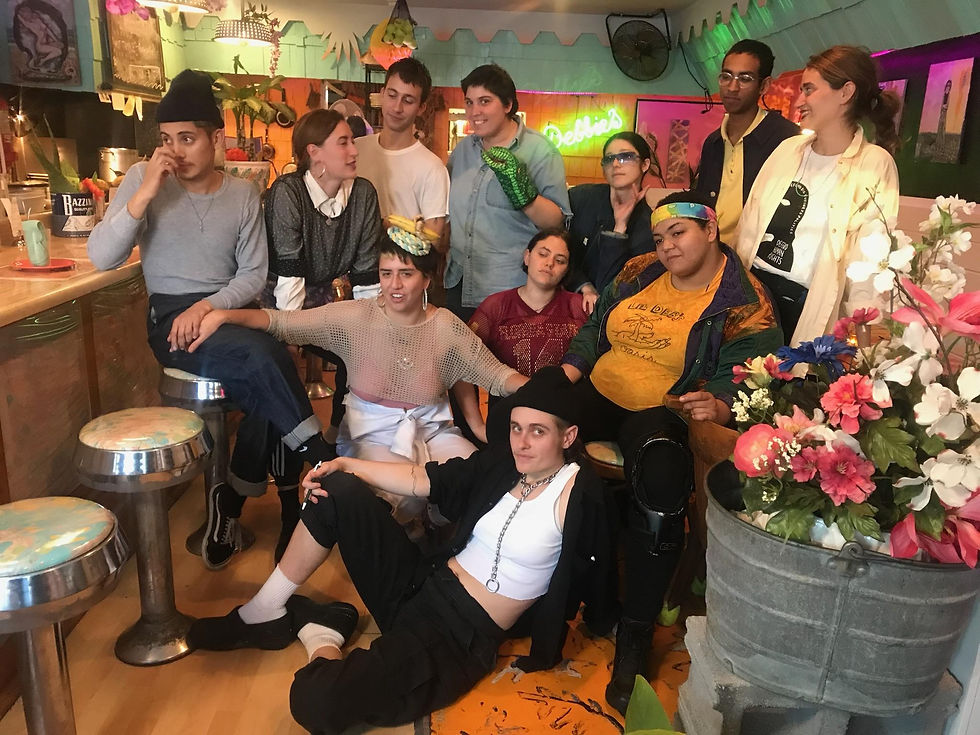
A Lil’ Deb’s crew inside the room they helped make run. Courtesy of Lil’ Deb’s Oasis.
The room got personal fast.
Carly and Dan Seibald first ate there on May 27, 2016. At first they were customers. Then they came often enough that reservation texts turned into actual texts, they ate flan with Halo’s grandmother, and the line between regular and friend got blurry.
Years passed. Babies came. Halo would carry one through the dining room so the adults could eat. Eventually the kids were old enough to have favorite songs from the restaurant playlist.
One night Carly’s husband asked Wheeler whether there was anything special happening off menu.
He was imagining the good stuff.
Something the kitchen had been messing around with. Something saucy. Something a regular might get because he knew somebody.
Wheeler looked at him and said, “I got you.”
Then he came back with three cherries sitting in a fancy cup of ice.
Carly still laughs about it.
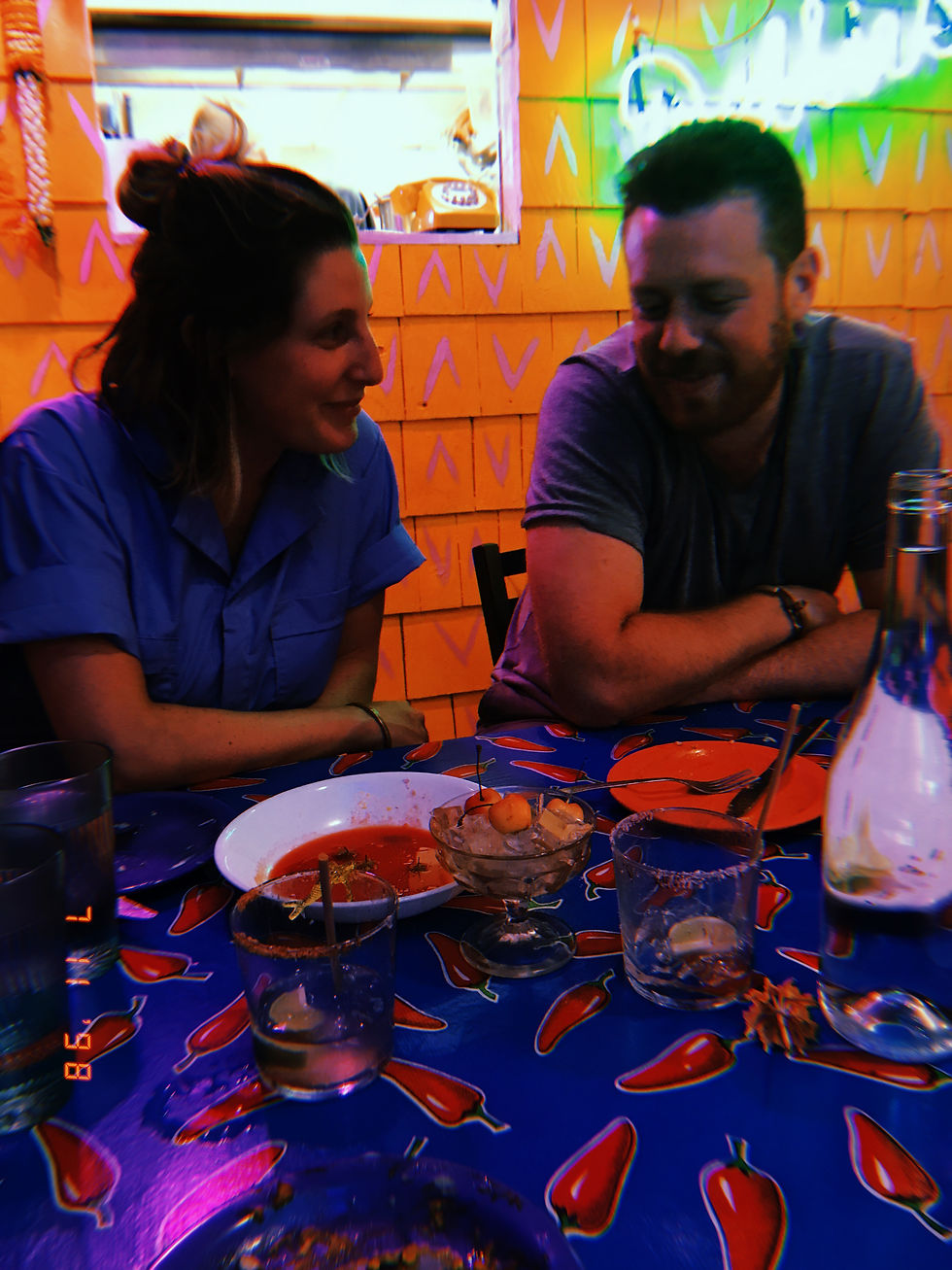
The little cup of cherries that became family lore — exactly the sort of thing no award list remembers. Photo by Justine Daum; courtesy Carly Seibald.
That stupid little story matters because it explains what the place was becoming before anybody outside Hudson knew to care.
Belonging could look like three cherries in a stupid cup.
It is also who knows your children.
In 2018, Carly and Dan lost a full-term pregnancy.
Their daughter’s name was Samara.
Afterward, Carly says Lil’ Deb’s was the only restaurant where she felt safe going out to eat. By then, the people working there knew more than her order.
Nobody had to be told why she might suddenly be quiet.
Nobody needed the short version.
They knew.
Wheeler had once used Samara’s name while describing a bottle of wine.
He saved the bottle for Carly and her husband.
She still has it.
Somewhere between those early shifts and the end of the decade, the rest of the country found Lil’ Deb’s.
Bon Appétit wrote about the restaurant early. Other national coverage followed. People who had never been to Hudson started recognizing that electric pink room. Food writers took the cooking seriously. Queer writers took the culture seriously. People began making trips around a dinner reservation.
By 2019, the James Beard Foundation had noticed too: Halo and Hannah were semifinalists for Best Chef: Northeast. In 2020, they appeared again as Best Chef: New York State semifinalists.
So yes, Lil’ Deb’s became famous.
The restaurant was becoming known nationally as a queer restaurant around the same time people inside it were living much quieter versions of what that meant.
Aristilde remembers looking around at work and seeing queer people everywhere. People changed names. Pronouns changed. Bodies changed. People were figuring themselves out while also figuring out who forgot table six’s drink.
“We existed, unapologetically and uncompromisingly as ourselves,” Aristilde wrote.
When Aristilde later had gender surgery, people from Deb’s were among the people who showed up.
She also remembers relationships inside the restaurant becoming painful later. A workplace that could feel like family could also make a rupture feel much bigger than quitting a job. When everybody has spent years talking about community and care, hurt does not suddenly become smaller because the time clock says this is employment.
Leo remembers a version of that tension too: politically radical people trying to make their values work inside a business that still had payroll and rent and hierarchy and Saturday nights when somebody called out sick.
“That tension has never been easy to reconcile,” he wrote.
Deb’s kept trying anyway.
Some workers remember feeling more free there than they had anywhere else.
Some remember pain.
Some remember both.
Meanwhile somebody still had to prep the fish.
Somebody had to mop.
Somebody had to keep the dish pit moving when every table in the restaurant was full.
And every once in a while, dinner stopped being about dinner for a minute.
Carly remembers a slammed service when a young man came inside hungry. He may have been drunk or high. Julia Johnson knew him.
There were people waiting. Tables needed things. Everybody was already busy.
Julia got him rice and beans and a soda.
She talked with him for a moment, walked him outside, thanked him for coming and returned to service.
No announcement.
No one stopped the room and congratulated themselves for being good people.
He was hungry.
She fed him.
2020 — THE ROOM DISAPPEARED
Then 2020 arrived and, for a while, nearly everybody had to.
Dining rooms closed.
Restaurants that survived had to turn themselves into something else fast.
Lil’ Deb’s shut down while the team figured out what came next. Management raised money to help staff, gave layoff bonuses and unemployment paperwork and, in one detail that could only belong to 2020, offered people toilet paper.
By summer they had built Fuego 69 behind Rivertown Lodge: an outdoor operation with socially distanced seating, a new menu and new safety protocols. Sixty-nine cents from each menu item went toward social-justice and mutual-aid causes.

Outdoor service during the pandemic era, when dinner had to move outside and the restaurant had to become something else fast. Courtesy of Lil’ Deb’s Oasis.
There was later a plan to move back indoors through an incarnation called CLÜB PRIVÉ.
It never opened.
Cases were climbing again, and the staff was laid off once more.
It was strange.
So was everything.
2021–2024 — IT CAME BACK DIFFERENT
When Lil’ Deb’s reopened in May 2021, it was the same address and not quite the same restaurant.
Some of the people who built the earliest Deb’s had moved on. Hannah stepped away from the restaurant by 2022 and Halo became its sole owner. Other cooks and servers came in. The place developed generations.
That is what ten years does.
The restaurant’s queer life also kept spilling well beyond Columbia Street.
Gili Rappaport remembers first understanding what Deb’s was becoming at the Lil’ Deb’s Oasis Gala Xtravaganza 2.0: The Garden of Earthly Delights — a multi-course dinner with live music, performances, a samba band and a late-night dance party all stacked into the same room.
Later, Gili worked with Halo and Ralph Hopkins on revivals of Ralph’s queer beach parties at Riis Beach in Queens. They rebuilt ten-foot flags and a mylar runway, mixed designers from Ralph’s 1990s parties with a younger generation, and brought queer elders and younger artists onto the same sand.

2022 — Venus Babes at Ralph’s Neon Oasis Beach Party, when part of Deb’s cultural life had traveled all the way to Riis Beach. Photo by Christian DeFonte.
At the 2022 Neon Oasis party, Star & Stan — Kate Williams and Reed Rushes — staged a campy performance right on the beach. Stan painted their body silver and wore assless chaps. Star wore a floor-length black gown.
Somewhere in there, I am sure there is an elegant sentence about cultural lineage.
But there were also silver assless chaps.
Both are important.
Gili remembers what the gatherings gave people in simpler terms.
They “didn’t have to shrink.”
The national attention followed the restaurant into this new era. In 2022, Halo and Hannah were again named Best Chef: New York State semifinalists while Lil’ Deb’s itself was named a semifinalist for Outstanding Hospitality. The restaurant earned another Outstanding Hospitality semifinalist nod in 2023.
The cookbook, Please Wait to Be Tasted, arrived in 2022 with more than seventy recipes plus the sex, music, friendship, clothes and parties that had been sneaking into dinner for years. It became a James Beard Award finalist.
2025 — ANOTHER GENERATION ARRIVES
Years later, Kelly Joyce would describe almost the same thing from a different generation of the restaurant. She started in 2025 and remembers being overwhelmed by how much she had to learn for what looked, at first, like a relatively small menu.
Everything had a reason.
The drinks had details. The food had details. If a guest asked a question, the person serving them needed to understand enough to bring them into it.
Kelly was a little intimidated by the people already working there. They seemed so comfortable in the space, so sure of what they knew and who they were inside it.
She remembers wondering whether, eventually, somebody new might walk in and think the same thing about her.
By the following year, she was a shift lead.
By then, Kelly also knew exactly whose work could disappear from a restaurant story if nobody bothered to name it.
When we asked Kelly whose work she did not want erased from the story, she immediately went behind the people guests usually noticed.
Arely on prep.
Johanna cleaning and keeping the dishes moving.
Carmen, who Kelly says has been there since the beginning and seems capable of doing nearly everything.
The people who arrive before the dining room looks beautiful and stay after everybody who photographed it has gone home.
The awards did not wash the forks.

A Lil’ Deb’s crew outside the Columbia Street storefront. Courtesy of Lil’ Deb’s Oasis.
You can tell a joke that made perfect sense in 2017 and get absolutely nothing back.
You can walk into a restaurant you helped open and discover that somebody else now knows where everything goes.
And eventually, somebody has to decide whether the thing keeps going.
2025–2026 — THE ENDING ARRIVES
The final years brought questions Deb’s could not solve by changing the lighting or moving dinner outside.
The business was put up for sale. A possible worker-owned future was explored. The building itself became part of the uncertainty. Staff lived for a while without knowing exactly what version of the restaurant, if any, would survive.
Kelly remembers the strange mixture when an answer finally came.
Sadness.
Fear.
Relief.
Curiosity.
She had been living inside the question long enough that knowing the ending was its own kind of comfort.
Halo announced that Lil’ Deb’s would close after ten years, with final service planned for October 12, 2026.
They called it “a beautiful decade.”
And they said something I keep coming back to.
“Closing the business is not a failure.”
Instead, Halo wanted to give Deb’s an “end of life” with as much “joy, dignity and grace as possible.”
End of life.
It is an odd phrase for a restaurant until you talk to enough people who lived inside one.
Then it makes complete sense.
Because what exactly are you closing after ten years?
A kitchen?
A business?
A room?
Or the place where somebody met their friends every week, where somebody got their first restaurant job, where someone learned to use a new name out loud, where a baby ate their first meal out, where a cook figured out who they wanted to become, where somebody got hurt, where somebody fell in love, where somebody got fed because they were hungry and nobody thought that needed a press release?
How do you close the place that still knows Samara’s name?
2026 — THE LAST SUMMER
Halo and the team are spending the final season feeding people.
IF YOU’VE BEEN MEANING TO GO, GO.
Lil’ Deb’s Oasis · 747 Columbia Street, Hudson
Final service is planned for Oct. 12. Parties under four are walk-in only; parties of four or more can reserve through Resy.
By the final season, some of those values were printed right on the check.
In its final season, Lil’ Deb’s kept its values right on the check: support for Stockbridge-Munsee cultural work, racial-justice and mutual-aid organizations, a Community Tab people could contribute to so somebody else could eat, and a living-wage fee designed to support compensation beyond the usual tipped-restaurant structure.
Former chefs are returning. There are dinners built around endings and memorials and the strange idea that grief and celebration can happen at the same table.
Which, when you think about it, is pretty much how Lil’ Deb’s has always worked.
Funny beside sad.
Art beside dinner.
Big ideas beside dirty dishes.
A national award sitting somewhere in the same universe as three cherries in a cup of ice.
By then, the room contains ten years at once.
The diner it replaced. The people who opened it. The people who left. The people who arrived late. The babies who got bigger. The staff who became other versions of themselves.
Eventually October 12 will come.
There will be a final service, even if nobody in the room wants to call the last plate the last plate while they are carrying it.
Somebody will wipe down the floral oilcloth.
Somebody will finish the dishes.
The music will stop.
The room that spent ten years collecting people will be quiet.
Annie will still remember Debbie doubling the pancakes.
Aristilde will remember the candles before service.
Kelly will remember Arely on prep, Johanna keeping the dishes moving and Carmen somehow knowing how to do nearly everything.
Somebody will still tell the story about the three cherries.
Carly will still have the bottle Wheeler saved for her — the one with Samara’s name on it.
And some of the smallest pieces of the place will still be sitting in somebody’s drawer.

One of the handwritten tickets that survived the decade — a tiny piece of the room remembering one of its regulars. Archival image by Carly Seibald.
Maybe that is what ten years inside a restaurant really amounts to.
Not one story everybody agrees on.


